

Business conditions ease slightly, expectations slip
Commentary on the Logistics Indicator Q2 2026 by Kai Althoff, Chairman of the Board of Bundesvereinigung Logistik (BVL) e.V. and CEO 4flow SE
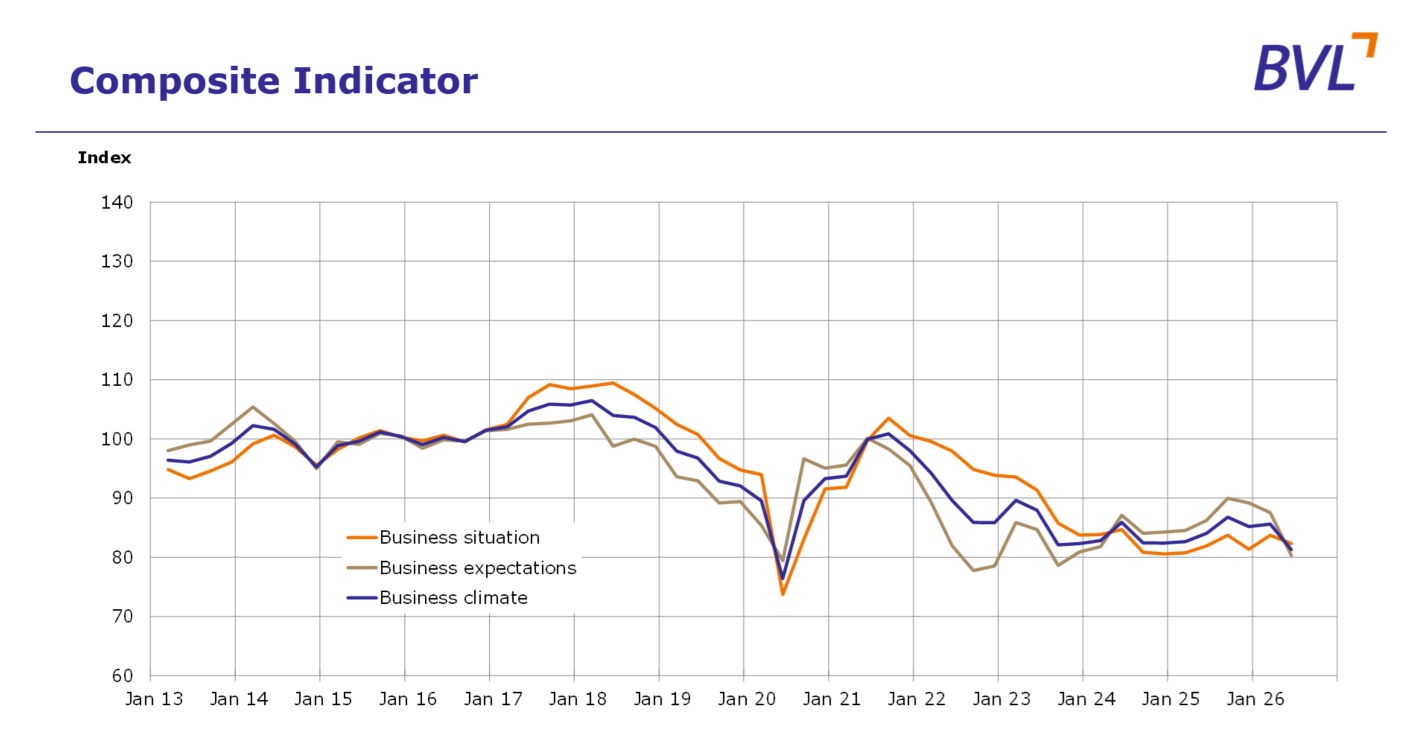
Following the logistics indicator’s relatively neutral reading in Q1, the logistics industry is facing stronger headwinds again in the second quarter of 2026. The ongoing conflict in Iran and the resulting strain on global supply chains are having a negative impact on sentiment in the logistics sector. This had not yet been reflected in the figures for Q1. The figures for Q2 are as follows: The business situation in Q2/2026 fell to 82.3 (from 83.7 in Q1/2026), a drop of 1.4 points. This is not a collapse, but a clear signal that the stabilization seen at the start of the year will not automatically continue. More significant is the trend in business expectations: they slip from 87.6 in Q1/2026 to 80.3 in Q2/2026, which is a sharp drop of 7.3 points. The business climate also declines significantly from 85.6 to 81.3 (4.3 points).
Shippers and service providers assess the situation regarding business expectations and the business climate similarly. There is a clear difference in the business situation: For shippers, it is stable and even 1 point higher than in Q1, while for service providers, it has declined sharply by 4 points compared to the previous quarter. This clearly illustrates the division of roles in the supply chains and shows that service providers are successfully mitigating risks for their customers.
A closer look at the monthly data shows that the downward trend in all three categories had already begun in March and April. In May, the figures stabilized again compared to April, showing a slightly positive trend. The logistics sector is thus currently developing in line with the Ifo Business Climate Index, which has followed a similar trend in all three categories over the past three months. Once again, recent months have highlighted the dependence of the logistics sector and the German economy as a whole on the global geopolitical situation. Whether a compromise between the U.S. and Iran will be reached soon—and how this will affect, among other things, traffic in the Strait of Hormuz—cannot be predicted. Since we cannot influence these circumstances, our focus must remain on making our supply chains resilient and flexible so that we can react quickly to changing conditions.
Downloads
- Detailed results ( PDF, 126 Kb)
- Commentary by BVL's President Kai Althoff ( PDF, 65 Kb)